
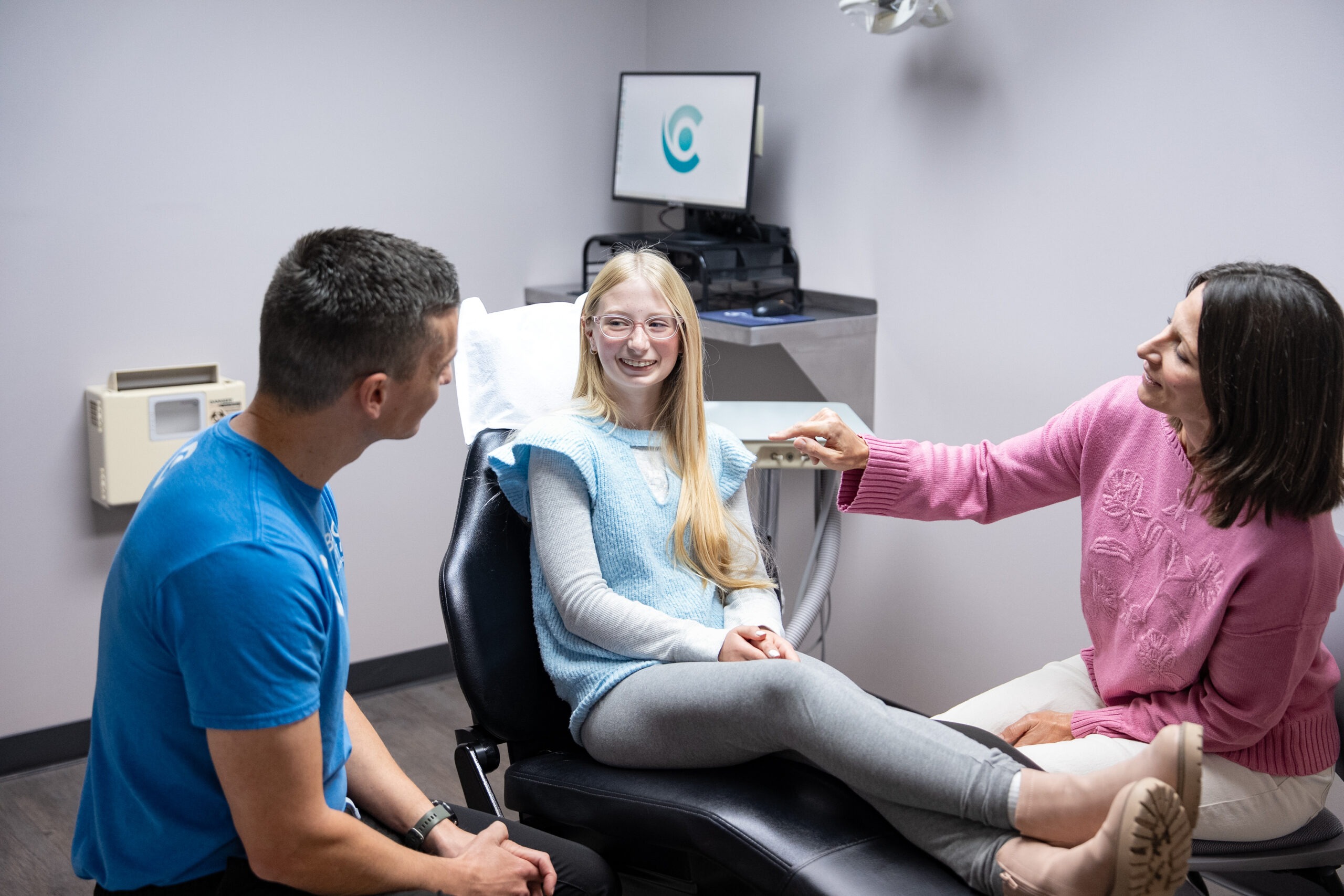
What really happens at your child’s first orthodontic evaluation is simpler than most parents expect: a short, gentle exam of the bite, jaw growth, and incoming teeth. There’s no drilling and no commitment to braces. The American Association of Orthodontists (AAO) recommends a first orthodontic check by age 7, when enough permanent teeth have arrived to spot developing concerns.
At its core, a first evaluation is a growth checkup for the mouth. Dr. Clabaugh looks at how the teeth are coming in, how the upper and lower jaws relate to each other, and whether anything is developing in a direction that will be harder to correct later.
Think of it as a diagnostic look, not a sales pitch.
Every evaluation ends with one of three answers: everything looks great and no follow-up is needed, growth should be watched over time, or early treatment would help right now. Most kids fall into that middle group and simply get rechecked as they grow.
You stay in the room the entire time. Dr. Clabaugh explains findings in plain language, using your child’s own photos and X-ray on the screen, so you can see exactly what he sees.
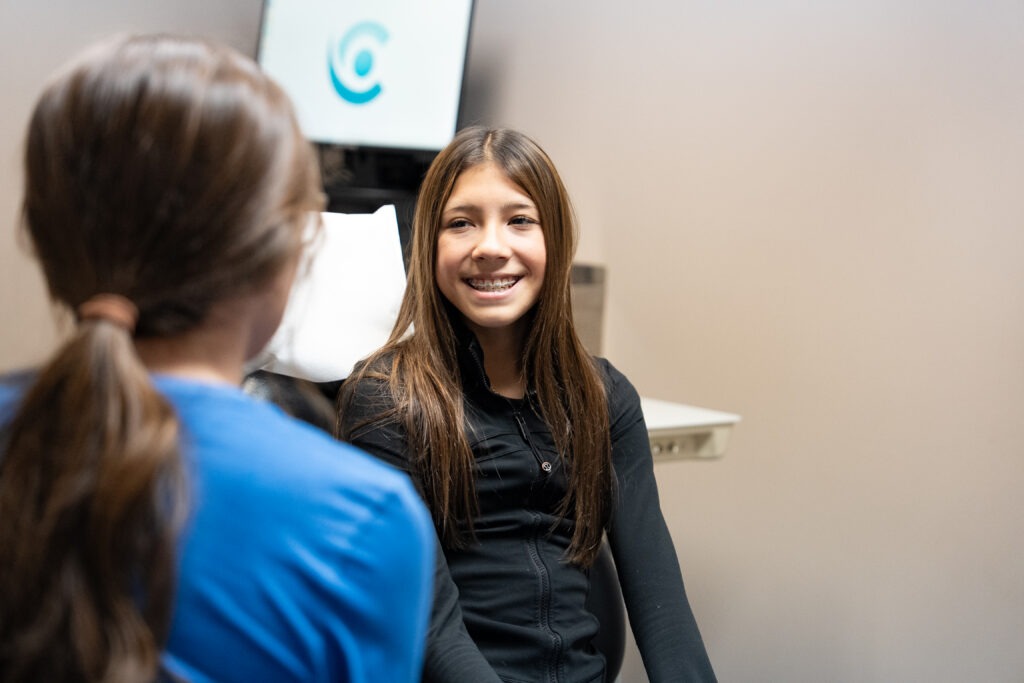
What Happens Step by Step at a First Orthodontic Evaluation?
A first orthodontic evaluation usually takes 30 to 60 minutes and follows a set order: check-in and health history, a visual exam of the bite, digital records including an X-ray and photos, and a plain-language review of findings with you. Most kids leave with a monitoring plan rather than braces.
Here’s how the visit typically unfolds:
- Check-in and health history. You’ll share medications, allergies, past dental care, and any habits you’ve noticed, like thumb-sucking, mouth breathing, or snoring. Small details matter more than parents realize.
- Visual exam. Dr. Clabaugh looks at how the upper and lower teeth meet, checking for crowding, spacing, crossbite, overjet (front teeth that stick out), open bite, and how the jaw joints move. He’ll also note tongue posture and airway signs.
- Digital records. A panoramic X-ray shows unerupted adult teeth, root position, and jaw development. Photos capture the smile from several angles. Many visits also include a 3D digital scan, which replaces the old putty trays with a small wand and takes just a few minutes.
- Review of findings. This is the part parents remember. Your child’s images go up on the screen, and each finding gets pointed out and explained without jargon. Ask whatever you want here, and most parents ask plenty.
- The recommendation. You’ll hear one of three plans: keep growing and recheck later, start Phase 1 treatment now to guide development, or wait for full treatment once more adult teeth arrive.
- Next steps. If monitoring makes sense, your child joins a growth-check schedule, usually every 6 to 12 months. Those visits are quick, and at Clabaugh Orthodontics they’re part of the smile squad, our club for kids who aren’t quite ready for treatment yet.
Nothing gets started without your go-ahead. If treatment is recommended and you’re ready, you can talk through timing and cost the same day.
Why Should My Child Get an Early Evaluation?
Timing is the real advantage. A growing jaw responds to guidance in ways a finished adult jaw simply can’t.
An early check can:
- Catch structural concerns while jaws are still growing, including crossbites, severe crowding, and adult teeth that are blocked or heading in the wrong direction.
- Create room for incoming teeth. Guiding growth at the right moment can reduce the odds that permanent teeth need to be removed later.
- Flag habits early. Thumb-sucking, prolonged pacifier use, and tongue thrust can gradually reshape the bite. Addressing them sooner keeps the changes from setting in.
- Protect front teeth that stick out. Protruding upper front teeth are more likely to get chipped or knocked during sports and playground tumbles.
- Build comfort with the office. Kids who visit early, get a tour, and leave with a high five tend to treat future visits as no big deal.
There’s also a quieter benefit: peace of mind. Sometimes the most useful answer a parent can get is “everything is developing beautifully, see you in a year.”
Early Evaluation vs. Waiting Until All Adult Teeth Are In
An evaluation at 7 rarely means braces at 7. It means information. Waiting until age 12 or older is perfectly appropriate for many kids, and plenty of children do great with one round of treatment as teens. The difference is knowing rather than guessing.
| Evaluation at age 7 | Waiting until age 12+ | |
|---|---|---|
| Jaw growth remaining | Significant growth left to guide | Most growth completed or nearly done |
| Treatment options | Growth guidance, space maintenance, habit correction, or simple monitoring | Braces or clear aligners once adult teeth are in |
| Typical outcome of the visit | Most children are monitored, not treated | Treatment planning usually begins |
| Likelihood of removing permanent teeth | May be lowered when crowding is managed early | Higher in cases of severe crowding |
| Typical treatment length | Phase 1 is usually a short round, often less than a year, followed by a resting break | One round, commonly about a year to two years depending on the case |
Phase 1 vs. single-phase treatment
Phase 1 is short, focused work done while baby teeth are still present, usually to correct a bite issue or make room. After a resting period, Phase 2 finishes alignment once the adult teeth have come in. Single-phase treatment skips the early round entirely and handles everything at once, which is the right call for most kids.
What Affects the Cost of a First Visit and Treatment?
Cost comes down to four main drivers: how complex the case is, how long treatment runs, which appliance is used, and whether care happens in one phase or two. Records such as X-rays, photos, and digital scans may be bundled into the exam or billed on their own, so it’s fair to ask before the visit.
At Clabaugh Orthodontics, the initial exam is a free consultation with no obligation, so finding out where your child stands doesn’t require a decision or a deposit. Nothing is recommended before you’ve seen the images and heard the reasoning behind it.
| Cost factor | Why it matters |
|---|---|
| Records | X-rays, photos, and digital scans are sometimes included in the exam and sometimes billed on their own, so it’s worth confirming when you book. |
| Case complexity | A mild crowding case and a significant bite correction require different amounts of work. |
| Treatment length | Longer treatment means more visits and adjustments. |
| Appliance type | Metal braces, clear braces, and clear aligners carry different price points. |
| One phase or two | Phase 1 plus Phase 2 is priced differently than a single round of treatment, since the work is split across two stages of growth. |
A few things worth asking about: most dental plans treat orthodontic benefits as a lifetime maximum rather than an annual one, so the benefit doesn’t reset each year. Interest-free monthly payment plans are widely available, and orthodontic care is typically FSA and HSA eligible.
If cost is the question sitting in the back of your mind, bring it up early in the visit. Our team walks families through these numbers every day, and a budget-friendly plan is usually easier to put together than parents expect.
Signs Your Child Is Ready for an Evaluation
Some signals are obvious. Others are easy to miss.
Schedule a check if you notice:
- Baby teeth lost early or late, or adult teeth arriving out of their usual order
- Crowding, overlapping, or front teeth that noticeably stick out
- Trouble chewing or biting into food, or frequent cheek and tongue biting
- A jaw that shifts to one side when closing, clicking sounds, or teeth that don’t meet properly
- Thumb-sucking past age 5, ongoing mouth breathing, or speech difficulties
- Teeth that look straight but bite together oddly, which often points to a bite issue rather than an alignment one
And here’s the part parents miss most: no symptoms at all still warrants a check by age 7. Several of the concerns that benefit most from early attention, like impacted canines or a developing crossbite, don’t cause discomfort and aren’t visible in a mirror.
Dr. Richard Clabaugh is a board-certified orthodontist who has spent his career growing smiles the right way, at the right time. Kids love us, parents trust us, and that trust starts with an honest answer at the very first visit, whether the answer is Phase 1 treatment, a growth-check plan, or simply good news and a recheck next year.
Families are welcome to schedule a free consultation with Clabaugh Orthodontics whenever you’re ready to learn more. No referral is required, and there’s no cost to find out what your child’s smile needs next.
Frequently Asked Questions
Does the first orthodontic evaluation hurt?
No. It’s a visual exam plus digital images, with nothing sharp and nothing invasive. The X-ray machine rotates around your child’s head while they stand still for a few seconds, and the 3D scanner is a small handheld wand. Most kids say it’s easier than a regular dental cleaning.
How long does the appointment take?
Plan on 30 to 60 minutes. That includes check-in, health history, the exam, records, and a full discussion of findings with you. If you decide to move forward with treatment, you may be there a bit longer to review options and payment plans.
Will my child get braces at the first visit?
Rarely. The majority of 7-year-olds are simply monitored while their adult teeth continue to arrive. Braces or appliances at this age are reserved for specific concerns like crossbites, severe crowding, or habits affecting jaw development.
What should we bring?
Bring your insurance card, any dental records or recent X-rays from your family dentist, and a written list of your questions. Parents often forget the concern that brought them in once the visit starts, so jot it down.
Does my child need a dentist referral?
No referral is required. You can schedule directly, and many families do. Your family dentist may still suggest a check, but their recommendation isn’t a prerequisite for booking.
How often are monitoring visits?
Usually every 6 to 12 months until your child is ready for treatment. These growth checks are quick, and they’re part of our smile squad program, so families can keep an eye on development as the adult teeth arrive.